Binaural Beats Explained: Facts and Common Myths
By StudyAide (Sound Producer & App Developer)·Published ·Updated
This lays out what binaural beats actually are, and where the known facts end and individual variation begins, without exaggeration. To be clear up front, this is not information that guarantees a medical treatment or an effect.
How binaural beats work
Play 200Hz in the left ear and 210Hz in the right, and instead of hearing two separate sounds the brain takes them as one sound rippling at 10Hz. That 10Hz beat is the binaural beat. No 10Hz sound is actually being played, since the human ear can't hear sound below 20Hz. The brain effectively calculates the difference between the two frequencies and creates it. In psychoacoustics, this is an auditory perception generated as the superior olivary complex in the brainstem integrates and processes subtle phase differences between acoustic signals from each ear.
This phenomenon only happens when the left and right sounds don't mix and reach each ear separately. That's why listening through speakers makes the two sounds combine in the air and the effect disappears. It's the reason earphones or headphones are essential. It also doesn't form well if you wear only one earbud or the volume is heavily weighted to one side.
Depending on the frequency difference, these names are commonly used.
- Delta (about 0.5 to 4Hz): the band discussed in connection with deep sleep
- Theta (about 4 to 8Hz): the band mentioned alongside light sleep, a drowsy state, and meditation
- Alpha (about 8 to 13Hz): the band talked about with a relaxed but awake state and light focus
- Beta (about 13 to 30Hz): the band linked to clear alertness and active thinking
These names are borrowed directly from the frequency ranges observed in an EEG. It's more accurate to read them as a marker that a track was built to target that band, not as a guarantee that "listening to an alpha track puts your brain in an alpha state."
A common myth: "it shifts your brainwaves to the state you want"
You'll easily run into the claim that binaural beats force your brainwaves into a particular state. The claim that they reliably raise focus or sleep quality tends to follow. But this part is not settled scientifically.
It isn't that research is missing. There are experiments on anxiety reduction and attention, and papers on brainwave entrainment. But samples are often small, control designs loose, or results in conflict with each other. Reviews that pool several studies also land at roughly "there may be an effect, but the evidence isn't consistent." The size of any effect, the time it takes to appear, and how long it lasts all vary by person.
So StudyAide does not present binaural beats as something that guarantees a medical treatment or a cognitive improvement. It is by no means a suggestion to use them in place of sleeping pills or focus supplements.
So why do so many people use them?
The effect not being fully proven doesn't mean they're useless. The place where they actually help is simpler.
A steady tone in the background makes the irregular noise around you jut out less. Sounds that pull at your attention, like a conversation at the next desk or a keyboard, get buried in the background sound. Many people also feel a psychological sense of calm from a repeating sound pattern. For some it hardens into a signal: "when this sound is on, it's study time," so just playing it flips the switch.
This isn't very different from the help that white noise, rain sounds, or lo-fi music give. Seeing binaural beats as one of the "background sounds that set a focused mood" keeps your expectations in the right place.
How StudyAide makes its binaural beats
Every binaural beat track in StudyAide is made in-house at the Pinkaide sound studio. We don't drop in pure-tone files floating around online or generate them with AI.
Two things get attention during production. First, the left and right frequencies that create the beat are kept exact, while the music laid over them is smoothed so it doesn't break your focus. There's no melody that suddenly swells and no lyrics, and it's mixed to keep flowing without grating even when left on for a long time. Second, since pure tones alone tire you quickly, a thin pad or natural sound is laid under them to wrap the tone softly. So StudyAide's tracks sound closer to calm background music than a lab-style "beep."
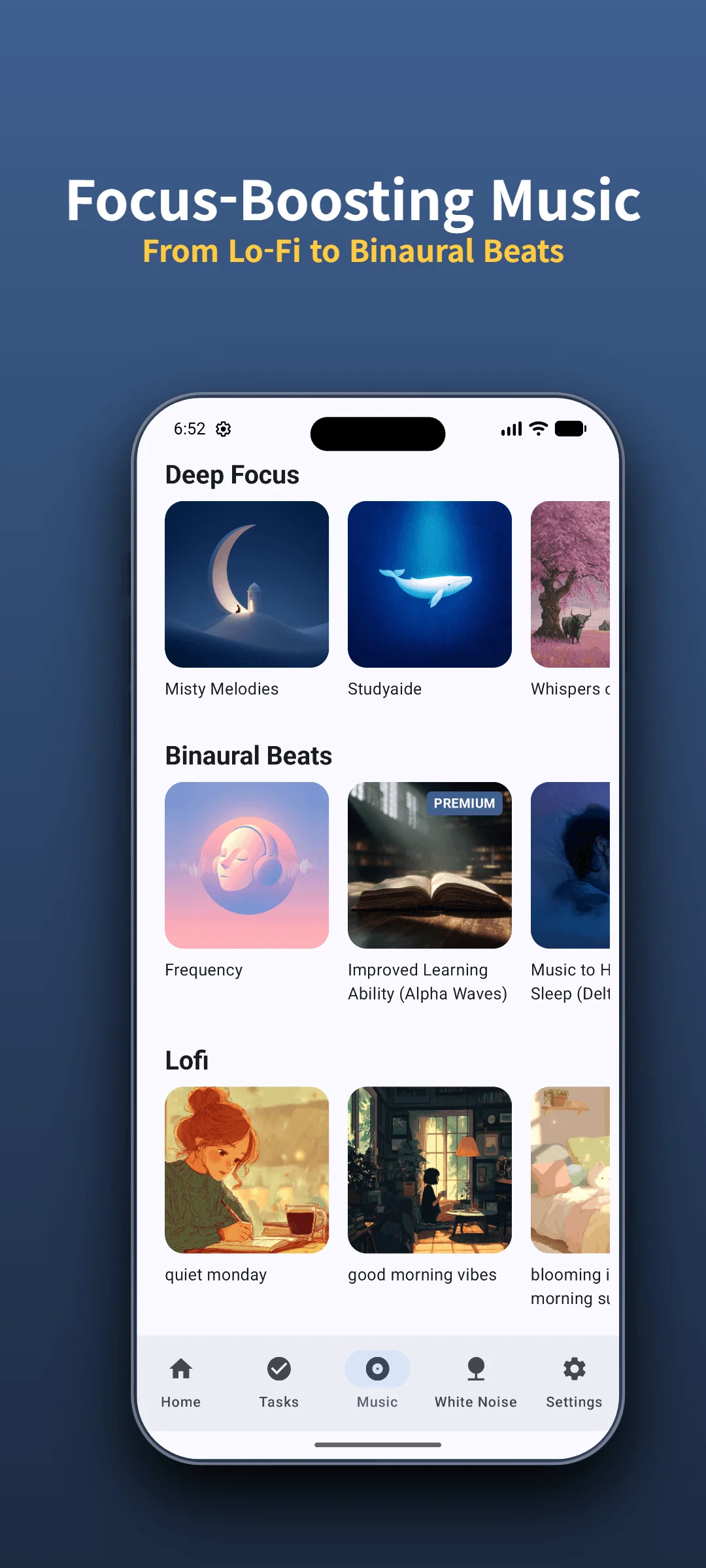
Hear binaural beats for yourself
Play alpha and delta tracks alongside white noise in StudyAide and check for yourself whether they suit you.
Install Free on Google PlayTry using them like this by situation
There's no fixed right answer, but here are combinations worth referencing on a first attempt, sorted by situation. Note that volume percentages here indicate relative balance within the app mixer rather than device master volume. For hearing health, keep overall device volume below 60% in line with World Health Organization (WHO) safe listening guidelines, ensuring conversational speech nearby remains audible.
- Focused daytime studying: put an alpha-band track at around 60% and lay white noise or rain over it at 30 to 40%. The background sound leads and the binaural beat supports from underneath. Start the Pomodoro timer at 25 minutes.
- Analysis or writing and other mentally heavy work: push a track closer to beta a little more to the front and lower natural sound to around 20%. Too much sound gets in the way, so keep the layers minimal.
- Night, rest, or before sleep: put a delta-band track as the main layer and play wave or gentle rain sounds with it. Set an auto-stop on the timer and the sound turns itself off after you fall asleep.
- If you're sensitive to sound: lay the binaural beat very low at 20 to 30% and use white noise as the main sound. Listen for a few days, and if it doesn't grate, raise it a little at a time.
For how to tune the Pomodoro timer to fit you, see the Complete Guide to the Pomodoro Timer. To choose effective sound combinations, check How to Choose a Free White Noise App With No Subscription. If you're comparing standalone mix setups with subscription focus music services, explore StudyAide vs Brain.fm.
Points to keep in mind while using them
- Listen through headphones or earphones so the left-right frequency difference comes across properly. Noise cancelling is fine either way.
- How much you feel it varies by person, so listen for a day or two and judge whether it suits you. It's better not to expect a big change from the start.
- Keep the volume low enough that you can still hear conversation. Constantly turning it up to cover noise strains your hearing.
- Don't use them while driving or while moving in a way that needs your attention.
- They don't replace a medical diagnosis or treatment. If sleep problems or trouble focusing continue, a professional consultation comes first.
- If you feel dizziness or discomfort, stop right away.
Clearing up the myths
- "Listening to an alpha track puts your brain in an alpha state" — you can't state it that flatly. It means the track was built to target that band.
- "The more you listen, the bigger the effect" — there's no basis for this. If anything, listening to pure tones for a long time can tire you.
- "Binaural beats are new technology" — the beat phenomenon itself was first described in 1839. What's new is laying it over music and listening through an app.
Wrap-up
Binaural beats are not a tool for steering your brain into the state you want. They're one of the background sounds that are good for focusing. Rather than overtrusting the effect, try them comfortably as one of several sounds and find the combination that fits you along the way. Mixing them with white noise, rain, and lo-fi while adjusting the volume is the most realistic way to use them.
Sources
- Ingendoh, R. M., Posny, E. S., & Heine, A. (2023). Binaural beats to entrain the brain? A systematic review of the effects of binaural beat stimulation on brain oscillatory activity, and the implications for psychological research and intervention. PLOS ONE. Of the 14 studies reviewed, 5 supported the entrainment hypothesis, 8 contradicted it, and 1 was mixed.
- Garcia-Argibay, M., Santed, M. A., & Reales, J. M. (2019). Efficacy of binaural auditory beats in cognition, anxiety, and pain perception: a meta-analysis. Psychological Research, 83, 357–372. A meta-analysis of studies on memory, attention, anxiety, and pain that reported a medium overall effect, with results depending on when the beats were played.
- World Health Organization (2015). Make Listening Safe. Guidelines recommending listening levels below 60% of maximum volume on personal audio devices to prevent recreational noise-induced hearing loss.
Find your own focus sound
Combine binaural beats, white noise, and focus music to build a sound that fits you.
 Install Free on Google Play
Frequently asked questions
What exactly are binaural beats?
When each ear hears a tone at a slightly different frequency, the brain perceives a new pulse equal to the difference between them. It's an auditory phenomenon, and you need earphones or headphones to notice it.
Do binaural beats change your brainwaves directly?
That isn't clearly established scientifically. Research exists, but results are mixed, and the size and durability of any effect vary from person to person. StudyAide does not present binaural beats as something that guarantees a medical treatment or a cognitive improvement.
If the effect isn't proven, why do so many people use them?
A steady tone in the background makes irregular noise around you stand out less, and many people feel a sense of calm from a repeating sound pattern. It works much like white noise or lo-fi music as a tool for setting a focused mood.
What should I keep in mind when using binaural beats?
You need headphones or earphones, and how much you feel depends on the individual. They do not replace a medical diagnosis or treatment, so if sleep problems or trouble focusing continue, talking to a professional comes first.
Can I listen through speakers?
It isn't recommended. Binaural beats arise only when separate frequencies reach each ear, so through speakers the two sounds mix in the air and the effect disappears. At that point it just sounds like background music.
People Behind StudyAide (Pinkaide)
Where audio craftsmanship meets lightweight app engineering
StudyAide is created jointly by a sound producer from Pinkaide (producing functional music since 2008, managing YouTube Content ID rights since 2016, and running the 120K-subscriber Relaxing Music channel) and an app developer building lightweight tools. Instead of generic AI loops or unverified tracks, we draw on years of acoustic expertise to craft fatigue-free, carefully mastered soundscapes designed for focus, relaxation, and deep sleep.
Related reading
Free White Noise App, No Subscription: 5 Checks
Choosing a free white noise app? Check five things: whether the sounds are truly free, offline playback, ad format, timer, and account requirements.
StudyAide vs Brain.fm: Subscribe to Focus Music?
Brain.fm sells focus music by subscription; StudyAide lets you mix white noise and music with no account. Compare sessions, research claims, and offline use.
The Complete Guide to the Pomodoro Timer
Why the Pomodoro Technique works, how to adjust 25 and 5 minutes to fit you, how to handle interruptions and lost focus, and how to use it alongside sound.